  View All Videos View All Videos |
 |
Analyze "Likes" on Facebook with Likester
The value of "Likes" on Facebook is growing in value as more and more brands strive to gain them. For this reason, it is not surprising that services such as Likester are surfacing to leverage this rich data. |
 |
Recent Videos:
 Google Files Patent for Social Hub Google Files Patent for Social Hub
Google recently filed a patent for, what may be, one aspect of its highly anticipated social strategy. Bill Slawski of SEO by the Sea first wrote about the filing on his site and hinted ...
 Lijit Closes Funding Round with Big Ambitions Lijit Closes Funding Round with Big Ambitions
Lijit Networks recently closed $10 million in financing. According to Todd Vernon, the CEO and Founder of Lijit, this funding will help ...
|
 |
 |
 |
 |
| Google Not Following Their Own Advice re: Duplicate Content |
By: bhartzer
I was looking around on Google.com and noticed over 26,000 (twenty six THOUSAND) pages of duplicate content on the Google.com domain. Here we are trying to get rid of low-quality content on our own sites and remove the duplicate content because of updates like the Google Panda update...and Google can't even follow their own advice.
Recently, while reading Google's own Webmaster Guidelines (http://www.google.com/support/), I read the Duplicate Content section. What caught my eye specifically was the 2nd bullet point on that page:
Be consistent: Try to keep your internal linking consistent. For example, don't link to example.com/page/ and example.com/page and example.com/page/index.htm.
It appears to me that Google is not following their own guidelines when it comes to duplicate content. In fact, Google has an extra 26,000 pages on their web site that should NOT be there: they're duplicates of other pages on the site.
Not only is Google linking internally to their directory pages, they're also linking to their /index.html pages, as well. Which are all duplicates.
I have screen shots and more specific examples of this on my recent blog post: http://www.billhartzer.com/
Maybe it's just me, but shouldn't Google themselves be expected to set an example here? Follow their own advice?
Reply to post |
 |
|

 | Thursday, May 12, 2011 |
 Health and Legal Queries Show Importance of Authority Health and Legal Queries Show Importance of Authority
There are a lot of elements of Google's Panda update to discuss, and we've certainly discussed many of them over the last few months, but let's not lose sight of the reason the update was launched to begin with - to improve search quality.
Do you think Google's search results are better now? Tell us what you think.
While quality is often in the eye of the beholder, there are certain kinds of queries where the information being retrieved is simply more important than others. We've talked about this before, as it's been a problem in some Google results.
One example we've looked at a few times is where an eHow article written by a freelance writer with no clear authority on cancer (and whose body of work includes a lot of plumbing-related articles) was ranking at the top of Googe's results for the query "level 4 brain cancer" above numerous other sources that would seem to be of greater authority on such a subject.
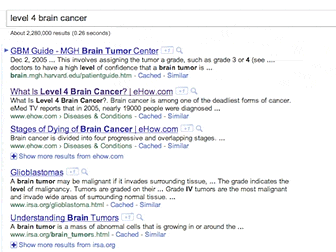
In fact, the article did get bumped down after the Panda update, but it does still rank number 2, followed by another result from eHow. Granted, this is just one example, and Demand Media has efforts in motion to improve its own content quality, but you get the point.
Queries related to things like health or law demand authoritative advice. Not SEO'd content.
We had a conversation with Mark Britton, founder and CEO of Avvo about this subject. Avvo is a site that offers Q&A forums where consumers can ask medical or legal questions and get responses from qualified doctors and lawyers. It provides apparently authoritative content in these two areas from certified professionals.
This seems like the kind of content that should be ranking well for a lot of these types of queries. Does it not? Britton thinks it's "very important" for commentary from experts in the medical and legal fields to surface high in search results for relevant topics.
"There is a lot of noise both online and offline regarding health and legal issues," he tells us. "This comes in the form of lay people, professional commentators and even celebrities who often offer advice that is well-intentioned but inherently inferior to that of a doctor or lawyer trained in the area. However, it is not always easy to get doctors and lawyers to speak. Some still look down on the Internet as a publishing or marketing vehicle. Others just downright fear it, as they have seen too many movies where someone says something on the Internet and they are subsequently hunted and killed by terrorist hackers."
"There is always room for improvement -- especially with our newer pages," he says of Avvo's own search rankings. "We just launched our doctor ratings directory and our free medical question and answer forum in November, and it will take some time for those pages to rank as well as our legally related pages."
Look at the results for a query like "Does type 2 diabetes shorten life expectancy?" Avvo's page on the subject ranks on the second page, while eHow ranks at the top of the first. The Avvo result has actually fallen since I began writing this article. It used to be right below the number one result from eHow and the number 2 from Yahoo Answers.
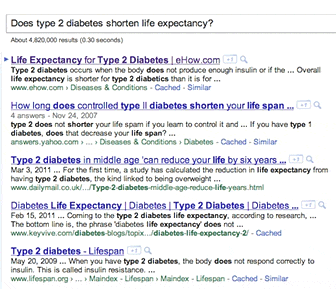
eHow's is an article (not very long by any means) by a guy whose bio says he "has been a freelance writer since 2007. He writes extensively in the fitness, mental health and travel sectors and his work has appeared in a range of print and online publications including Scazu Fitness and USAToday Travel Tips...[and] holds a Master of Arts in community psychology."
Keep in mind that USA Today has a deal with Demand Media for travel tips. So that presumably means his Demand Media content is simply published by USA Today. Does "Master of Arts in community psychology" indicate more authority to answer a life/death question about type 2 diabetes than say a licensed and practicing MD? That's who provided an answer on Avvo's page, which just got pushed further down in the search results.
Should authority and certification of expertise carry greater weight in Google's search rankings? Comment here.

|
![[Digg This!]](http://images.ientrymail.com/webpronews/videosite/digg.gif)
![[Facebook]](http://images.ientrymail.com/webpronews/videosite/facebook.png)
![[Twitter]](http://images.ientrymail.com/webpronews/videosite/twitter.png)
![[StumbleUpon]](http://images.ientrymail.com/webpronews/videosite/stumbleupon.png)





1 comment:
thanks for sharing
web design perth
Post a Comment